Understanding Budget Reality in The Perspective of Symbolic Interactionism
DOI:
https://doi.org/10.21632/irjbs.9.2.105-118Keywords:
budget, capitalist, symbolic interactionism, principal, agentAbstract
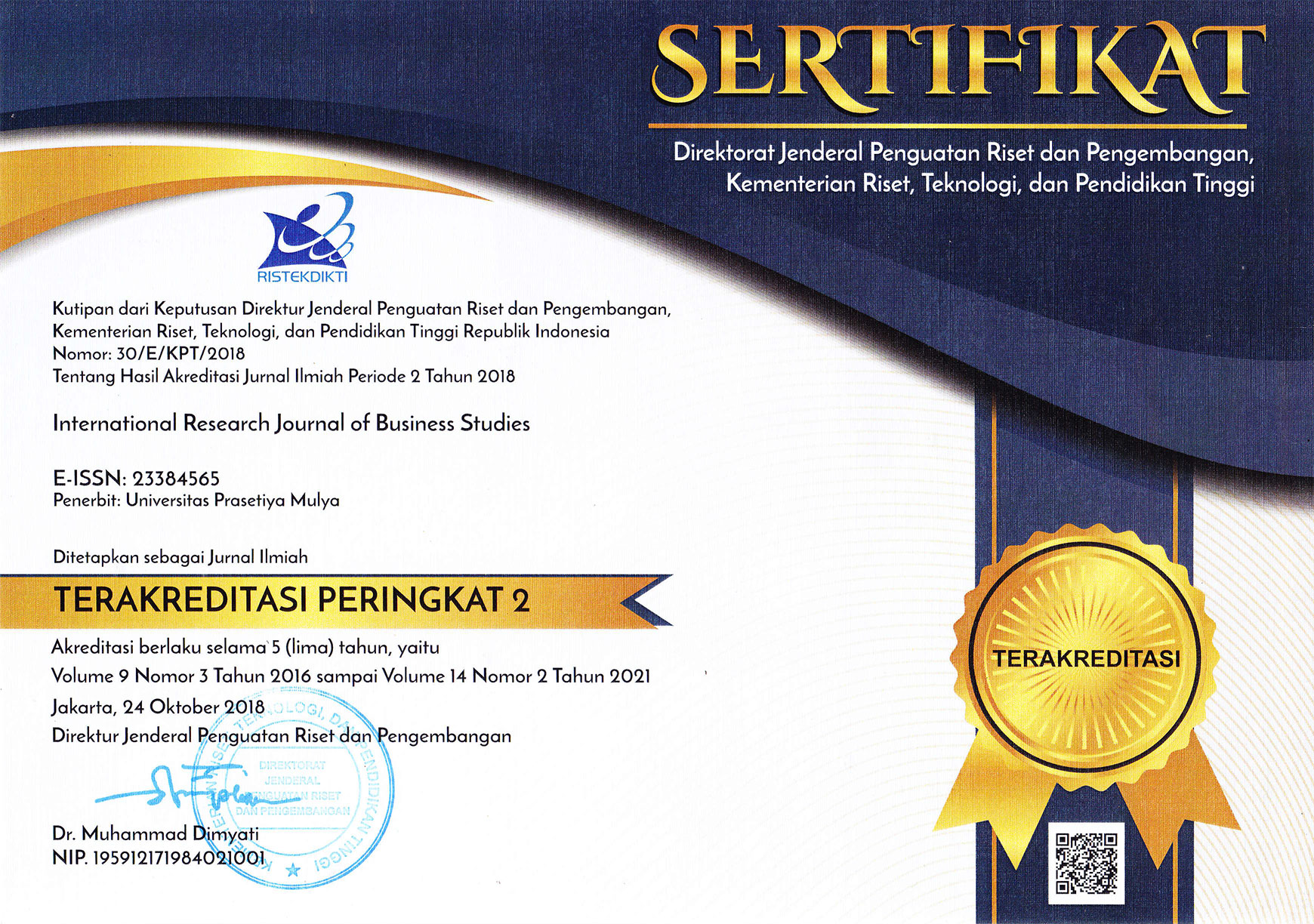
This study aims to interpret the meaning of budget on one of the StateOwned Enterprises (SOEs) to minimize conflict between principal and agent. Analysis is done using symbolic interactionism method in interpretive paradigm. Data collection is conducted using in-depth interviews with informants who are very familiar with budgeting in PT Perkebunan Nusantara (PTPN). The results of this study reveal that budgeting process involves the interaction and action between the principal and the agent based on their own experiences in preparing the budget. Decision making is sorely needed, especially in a condition where an individual is able to free himself from the crisis called epiphany. Epiphany is a moment of experience that makes an impression on one’s life so as to form a character is called epiphany. It could be said that epiphany is the most critical moment ever experienced by someone that cannot be forgotten(Denzim, 1989) Social fact describes that a capitalistic company ownership thinks of itself with the purpose of fulfilling personal desires and prosperity, so in implementing budget preparation consisting of the symbol of numbers, it is always covered by passion of greed. Conflict of interest is very noticeable when the preparation and adoption of the budget is filled with a variety of interests. Regulatory system is becoming part of legitimate stage of budgeting that has become the elements of capitalist company ownership that eventually reap capitalist values in the accounting information, in which the decisions and the economic actions are also based on the capitalist values. The implication of this research is expected to provide practical recommendations to the good cooperation between the agent and principal in preparing the budget.
References
Azhar. A. (2013). Politisi Anggaran BUMN. Berita Medan. Jumat, 29 Nov 2013 08:41 WIB - http://mdn.biz.id/n/65018/. Di akses 23 Januari 2015.
Amagoh, F. (2009). Information Asymmetry and the Contracting Out Process. The Innovation Journal: The Public Sector Innovation Journal Volume 14(2), 2009, Article 3.
Bartle. John R., and Shields Patricia, (2008). Applying Pragmatism to Public Budgeting and Financial Management. Association for Budgeting and Financial Management conference. October 24, 2008. Chicago, Illinois.
Bernardo. A, Cai. H, Luo. J. (2004). Capital Budgeting in multidivision firms: information, agency, and incentives. The review of financial studies vol.17 no.3.
Buckova, M. (2015). Management Accounting and Agency Theory. Procedia Economics and Finance 25 ( 2015 ) 5 – 13.
Burrell, Gibson., Morgan, Gareth. (1979). Sociological Paradigms and Organisational Analysis: Elements of the Sociology of Corporate Life. London: Heinemann.
Creswell. JW. (2013). Penelitian Kualitatif dan Desain Riset (A. L. Lazuardi, Penerjemah. 1 ed) Yogyakarta: Pustaka Pelajar.
Denzin, Norman. K. (1989). Interpretive Interactionism. Applied Social Research Methods Series Volume 16. London: Sage Publication.
Eisenhardt, Kathleen. (1988). Agency and institutional explanations of compensation in retail sales. Academy of Management Journal, 31, pp. 488-511.
Harahap. S. (2007). Krisis Akuntansi Kapitalis dan Peluang Akuntansi Syariah. Pustaka Quantum.
Hariyanti, W, Purnamasari, P, dan Lestira, M. (2015). Pluriform motivation as antecedent and its relationships to budgeting participation and managerial performance (Empirical Study on Manufacturing Companies listed on Indonesian Stock . Procedia - Social and Behavioral Sciences 211 ( 2015 ) 836 – 843.
Haryanti, I., Othman, R. (2012). Budgetary Participation: How It Affects Performance And Commitment. Accountancy Business and the Public Interest (2012).
Indriantoro, Nur. (2000). An Empirical Study of Locus of Control and Cultural Dimensions as Moderating Variable of The Effect of Participative Budgeting on Job Performance and Job Satisfaction.J urnal Ekonomi dan Bisnis Indonesia, Vol. 15 (1), Januari: 97-114.
Jensen, Michael C. and W.H. Meckling. (1976). Theory of the Firm: Managerial Behavior, Agency Costs and Ownership Structure. Journal of Financial Economics 3 (4), pp. 305-360.
Kasser. T., Kanner, Chon, and Ryan. (2007) . Psychology and American corporate capitalism, further reflection and future direction. Psychological inquiry, 18 (1), 60-71.
Kilfoyle, Richardson. (2010). Agency and structure in budgeting: Thesis, Antithesis and Synthesis. Critical Perspectives on Accounting 22 (2011) 183–199.
Lesmana, S. (2004). Pengaruh Ketidakpastian Lingkungan yang Dipersepsikan dan Strategis Kompetitif Terhadap Hubungan System Control Akuntansi dengan Kinerja Perusahaan.Simposium Nasional Akuntansi VII, Denpasar.
Liapis, K, Spanos, P. (2015). Pulic accounting analysis under budgeting and controlling process: The greek’s evidence. Procedia Economic and finance. 33 (2015) 103-120.
Libby, T. and R. M. Lindsay. (2010). Beyond Budgeting or Budgeting Reconsidered? A Survey of North American Budgeting Practice. Management Accounting Research , 21: 56-75.
Ludigdo, Unti. (2006). Strukturasi Praktik Etika di Kantor Akuntan Publik: Sebuah Studi Interpretif. Simposium Nasional Akuntansi 9, Padang, 23-26 Agustus.
Muhajir, N. (2011). Metodologi Penelitian: Paradigma Positivisme Objekif Phenomenologi Interpretif Logika Bahasa Platonis, Chomskyist, Hegelian & Hermeneutik Paradigma Studi Islam Matematik Recursion, Set-Theory & Structural Equation Modeling dan Mixed. Rake Sarasin. Yogyakarta.
Mulawarman, AD. (2014). On Holistic Wisdom Core Datum Accounting: Shifting from ccounting Income to Value Added Accounting. The International Journal of Accounting and Business society.Vol. 22, No. 1 August 2014, pp. 69-91. Universitas Brawijaya.
Moleong, L . (2006). Metodologi Penelitian Kualitatif. Edisi Revisi. Remaja Rosdakarya. Bandung.
Morris, R D. (1987). Signaling, Agency Theory, and Accounting Policy Choice. Accounting of Business Research, 18 (69), pp. 47-56.
Rachmawati, A. dan Triatmoko, H. (2010). Analisis Faktor-Faktor yang Mempengaruhi Kualitas Laba dan Nilai Perusahaan. Simposium Nasional Akuntansi X Makasar.
Ritzer, G., Dan Goodman, D.J. (2013). Teori Sosiologi dari Teori Sosiologi Klasik Sampai Perkembangan Mutakhir Teori Sosiologi Postmodern. Cetakan Kesembilan. Kereasi Wacana. Bantul.
Scott, William R. (2009). Financial Accounting Theory, fifth edition, Prentice Hall, Pearson Canada Inc., Toronto, Ohio.
Supriyono, R.A. (2005). Pengaruh Komitmen Organisasi, Keinginan Sosial, dan Asimetri Informasi terhadap Hubungan Antara Partisipasi Penganggaran dengan Kinerja Manajer. Jurnal Ekonomi dan Bisnis Indonesia, Vol. 20, No. 1.
Takaoka, S. (2005). The effects of product liability costs on R&D with asymmetric information. Japan and the world economy. 17 (2005) 59-81.
Triyuwono. Iwan.( 2012). Akuntansi Syariah Perspektif, Metodologi, dan Teori. Jakarta. Rajagrafindo Persada.
Tsuji, K. (2007). The soft budget constraint, the debt overhang andthe optimal degree of credit centralization. Japan and the world economy. 19 (2007) 187-197.
Tyson, Oldroyd, Fleischman. (2013). Was America born capitalist? A counter view. Critical Perspectives on Accounting 24 (2013) 379–396.
Undang-Undang Republik Indonesia Nomor 19 Tahun 2003 Tentang Badan Usaha Milik Negara.
Widana, P. (2014). The influence of participative budgeting on budgetary slack in composing local governments’ budget in Bali province. Procedia - Social and Behavioral Sciences164 ( 2014 ) 391 – 396
Yucel R, Gunluk, M. (2009). Effects of budgetary control and justice perception on the relationship between budgetary participation and performance. Journal of global strategic management 02 (2007).
Downloads
Submitted
Published
How to Cite
License
Copyright (c) 2016 Lilis Ardini, Nurul Hasanah Uswati Dewi

This work is licensed under a Creative Commons Attribution-ShareAlike 4.0 International License.
Journal Author(s) Rights
For IRJBS to publish and disseminate research articles, we need publishing rights (transferred from the author(s) to the publisher). This is determined by a publishing agreement between the Author(s) and IRJBS. This agreement deals with the transfer or license of the copyright of publishing to IRJBS, while Authors still retain significant rights to use and share their own published articles. IRJBS supports the need for authors to share, disseminate and maximize the impact of their research and these rights, in any databases.
As a journal Author, you have rights to many uses of your article, including use by your employing institute or company. These Author rights can be exercised without the need to obtain specific permission. Authors publishing in IRJBS journals have comprehensive rights to use their works for teaching and scholarly purposes without needing to seek permission, including:
- use for classroom teaching by Author or Author's institution and presentation at a meeting or conference and distributing copies to attendees;
- use for internal training by the author's company;
- distribution to colleagues for their research use;
- use in a subsequent compilation of the author's works;
- inclusion in a thesis or dissertation;
- reuse of portions or extracts from the article in other works (with full acknowledgment of the final article);
- preparation of derivative works (other than commercial purposes) (with full acknowledgment of the final article);
- voluntary posting on open websites operated by the author or the author’s institution for scholarly purposes,
(But it should follow the open access license of Creative Common CC-by-SA License).
Authors/Readers/Third Parties can copy and redistribute the material in any medium or format, as well as remix, transform, and build upon the material for any purpose, even commercially. Still, they must give appropriate credit (the name of the creator and attribution parties (authors' detail information), a copyright notice, an open access license notice, a disclaimer notice, and a link to the material), provide a link to the license, and indicate if changes were made (Publisher indicates the modification of the material (if any) and retain an indication of previous modifications.
Authors/Readers/Third Parties can read, print and download, redistribute or republish the article (e.g. display in a repository), translate the article, download for text and data mining purposes, reuse portions or extracts from the article in other works, sell or re-use for commercial purposes, remix, transform, or build upon the material, they must distribute their contributions under the same license as the original Creative Commons Attribution-ShareAlike (CC BY-SA).

This work is licensed under a Creative Commons Attribution-ShareAlike 4.0 International License.