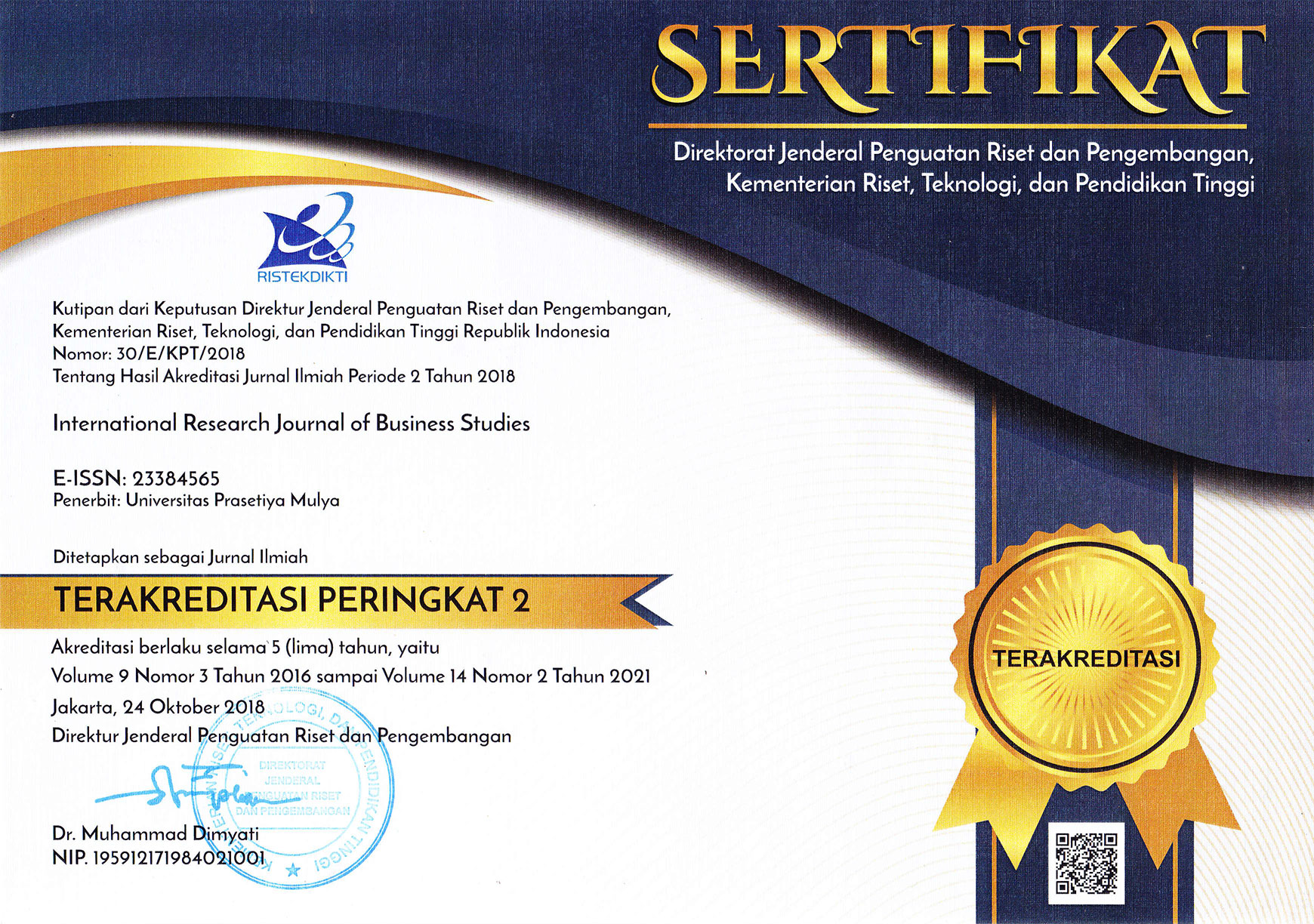
Predicting Intention to Purchase Counterfeit Products: Extending the Theory of Planned Behavior
DOI:
https://doi.org/10.21632/irjbs.7.2.109-120Keywords:
values consciousness, past behavior, theory of planned behavior, counterfeit productsAbstract
This research was designed to test the ability of an extended theory of planned behavior (TPB) to predict purchase intention of counterfeit products. Value consciousness and past behavior are variables that added into the TPB. Three hundred and fifty respondents completed the research questionnaires. Questionnaires were distributed to respondents by email and drop-off/pick-up method. The data then analyzed using structural equation modeling (SEM). All Hypothesis were supported. This research also provides the managerial implication and suggestion for future research.
References
Abid, M. and Abbasi, M. (2014). Antecedents and outcomes of consumer buying attitude; the case of Pakistani counterfeit market. Indian J. Sci. Res, 8,1 165-176.
Ajzen, I. (1991). The theory of planned behavior. Organizational Behavior and Human Decision Processes, 50, 179-211.
Ajzen, I. and Klobas, J. (2013). Fertility intention: an approach based on the theory of planned behavior. Demographic Research, 29, 8, 203-232.
Ali, H. (2008). Why people buy counterfeit brands. Available at www.open.edu/penlearn/society/the-law/criminology/whypeople-buy-counterfeit-brands (accessed July 15).
Ang, S.H., Cheng, P.S., Lim, E.A.C. and Tambyah, S.K. (2001). Spot the difference: consumer responses towards counterfeits. Journal of Consumer Marketing, 18, 219-235.
Augusto de Matos, C., Ituassu, C. and Rossi, C. (2007). Consumer attitudes towards counterfeits: a review and extension. Journal of Consumer Marketing, 24 (1), 36-47.
Bagozzi, R.P., Baumgartner, H. and Yi, Y. (1992). State versus action orientation and the theory of reasoned action: an application to coupon usage. The Journal of Consumer Research, 18 (4), 505-518.
Baumgartel. T. (2007). The social significance and consequences of digital piracy in South East Asia: the case of independent filmmakers. Phillipine Sociological Review, 55, 50-63.
Barton, A.( 2007). Face Up to the Fraudsters. Supply Management. 12, 17.
Beck, L and I. Ajzen (1991). Predicting Dishonest Actions Using The Theory of Planned Behavior. Journal of Research in Personality, 25, 285-301.
Bian, X. and Moutinho, L. (2009). An investigation of determinants of counterfeit purchase
Consideration. Journal of Business Research, 62 (3), 368-378.
Bian, X., and Moutinho, L. (2011). The role of brand image, product involvement, and knowledge in explaining consumer purchase behavior of counterfeits: Direct and indirect effects. European Journal of Marketing, 45 (1/2), 191-216.
Bloch, P.H., Bush, R.F. and Campbell, L. (1993). Consumer ‘accomplices’ in product counterfeiting. Journal of Consumer Marketing, 10, 27-36.
Booth, K.S., Larson, G.E. and Miyoshi. D.K. (2007). Social desirability effects on computerized and paper-and-pencil questionnaire. Computers in Human Behavior. 23, 1, 463-477.
Byrne, P.M. (2007). Mastering Supply Chain Security. Logistics Management. 46, 25.
Casabona, L. (2006). Supply Chain a Key in Counterfeit Battle. Women’s Wear Daily. 192, 9.
Chung, J. and G. S. Monroe (2003). Exploring Social Desirability Bias. Journal of Business Ethics, 44 (4), 291-302.
Colliens, S.E. and Carey, K.B. (2007). The theory of planned behavior as a model of heavy episodic drinking among college students. Psychol Addict Behav. 21, 4, 498-507.
de Matos, C.A., Ituassu, C.T. and Vargas, C.A. (2007). Consumer attitudes toward counterfeits: a review and extension. Journal of Consumer Marketing, 24 (1), 36-47.
Eisend, M. and Schuchert-Guller, P. (2006). Explaining counterfeit purchases: a review and preview. Academy of Marketing Science Review, available at: www.amsreview.org/ articles/eisend12-2006.pdf (accessed January 25).
Eser, Z., Kurtulmusoglu, B. Bicaksiz, A. and Sumer, S.I. (2015). Counterfeit Supply Chains. Procedia Economics and Finance. 23, 412 – 421.
Ewing, M.T. (2000). Brand and retailer loyalty: past behavior and future intentions. Journal of Product & Brand Management, 9 (2), 120-127.
Fang, J., Prybutok, V. and Wen, C. (2016). Shirking behavior and socially desirable responding in online surveys: A crosscultural study comparing Chinese and American samples. Computers in Human Behavior. 54, 310-317.
Franses, P.H. and Lede, M. (2010). Diffusion of original and counterfeit products in a developing country. Economic Institue Report 2010-08. Erasmus School of Economics, Netherland.
Gabler, J. and Jones, M.Y. 2000. Behavior and behavioral intentions in a retail setting. ANZMAC 2000 Visionary Marketing for the 21st century: facing the challenge. Available at: http://www.wmib.vuw.ac.nz:8081/www/ANZMAC2000?CDsite/.../g/
Gabler1.PDF.
Gentry, J.W., Putrevu, S. and Shultz, C.J. (2006). The effect of counterfeiting on consumer search. Journal of Consumer Behavior, 5, 245-56.
Hasbullah, N., Mahajar, A.J. and Salleh, M.I. (2014). A conceptual framework of extending the theory of planned behavior: the role of service quality and trust in the consumer cooperatives. International Journal of Business and Social Science, 5, 12, 142-148.
Hawkins, D.I. and Mothersbaugh, D.L. 2010. Consumer Behavior: Building Marketing Strategy, 11th ed., NY: McGraw-Hill/Irwin.
Huang, Y. and Wu, Y.J. (2010). Decision making in online auctions. Management Decision, 49 (5), 1-25.
Kim, H.Y. and Chung, J. (2011). Consumer purchase intention for organic personal care products. Journal of Consumer Marketing, 28 (1), 40-47.
Krippendorf, K. (2004). Content analysis: an introduction to its methodology. 2nd ed. Thousand oaks, CA: Sage.
Lefkoff-Hagius, R., & Mason, C. H. (1993). Characteristics, beneficial, and image attributes in consumer judgments of similarity and preference. Journal of Consumer Research, 20, 100-110.
Lelkes, Y., Krosnick, J. Marx, D., Judd, C. and Park. B. (2012). Complete anonymity compromises the accuracy of self-reports. Journal of Experimental Social Psychology, 48, 1291-1299.
Lewis, K. (2009). The fake and the fatal: the consequences of counterfeits. The Park Place Economist, XVII, 47-58.
Lysonski, S. and Durvasula, S. (2008). Digital piracy of MP3: consumer and ethical predispositions. Journal of Consumer Marketing, 25, 167-78.
Nakassis, C.V. (2012). Counterfeiting what? Aesthetics of brandedness and brand in Tamil Nadu, India. Anthropological Quarterly, 85, 3, 701-721.
Newel, S. (2013). Brand as masks: public secrecy and the counterfeit in Cote d’Ivoire. Journal of the Royal Anthropological Institute, 19, 138-154.
Pamela S. Norum Angela Cuno (2011). Analysis of the demand for counterfeit goods. Journal of Fashion Marketing and Management: An International Journal, 15 (1), 27 – 40
Penz E. and Stöttinger B. (2005). Forget the “real” thing-take the copy! an explanatory model for the volitional purchase of counterfeit products. Advances in Consumer Research, 32(1), 568–75.
Penz, E., Schlegelmilch, B.B. and Stottinger, B. (2009). Voluntary purchase of counterfeit products: empirical evidence from four countries. Journal of International Consumer Marketing, 21, 67-84.
Phau, I., Prendergast, G. and Chuen, L.H. (2001). Profiling brand-piracy-prone consumers: an exploratory study in Hong Kong’s clothing industry. Journal of Fashion Marketing & Management, 5, 45-55.
Phau, I., Teah, M. and Lee, A. (2009).Targeting buyers of counterfeits of luxury brands: A study on attitudes of Singaporean consumers. Journal of Targeting, Measurement & Analysis for Marketing, 17(1), 3-15.
Rutter, J. and Bryce, J. (2008). The consumption of counterfeit goods: ‘here be pirates?’. Sociology, 42, 6, 1146-1164.
Schreier, M. (2012). Qualitative content analysis in practice. India: Sage.
Sharma, P. (2011). Country of origin effects in the developed and emerging markets: exploring the contrasting roles of materialism and value consciousness. Journal of International Business Studies, 42, 2, 285-306.
Spink, J., Mayer, D.C., Park, H. and Heinonen, J.A. (2013). Defining the types of counterfeiters, counterfeiting, and offender organizations. Crime Science, 2, 8, 1-10.
Swami, V., Chamorro-Premuzic, T. and Furnham, A. (2009). Faking it: personality and individual difference predictors of willingness to buy counterfeit goods. The Journal of Socio-Economics, 38, 820-825.
Tom, G., Garibaldi, B., Zeng, Y. and Pilcher, J. (1998). Consumer demand for counterfeit goods. Psychology & Marketing, 15, 405-421.
Trott, P. and Hoecht, A. (2007). Product counterfeiting, non-consensual acquision of technology and new product development an innovative perspective, European Journal of Innovation Management, 10, 126-143.
Wan, W.W.N., Luk, C., Yau, O.H.M., Tse, A.C.B., Sin, L.Y.M., Kwong, K.K. and Chow, R.P.M. (2009). Do traditional Chinese cultural values nourish a market for pirated CDs? Journal of Business Ethics, 88, 185-196.
Wang, F., Zang, H., Zang, H. and Ouyang, M. (2005). Purchasing pirated software: an initial examination of Chinese consumers. Journal of Consumer Marketing, 22, 340-51.
Wah-Leung, C. and Prendergast, G. (2006). Buyer’s perceptions of pirated products in China. Marketing Intelligence & Planing, 24, 446-462.
Wilcox, K., Kim, H.M. and Sen, S. (2009). Why do consumers buy counterfeit luxury brands. Journal of Marketing Research, XLVI, 247-59.
Yar, M. (2005). A deadly faith in fakes: trademark theft and the global trade in counterfeit automotive components. Internet Journal of Criminology, 1-33. Available at www.internetjournalofcriminology.com
Yoo, B. and Lee, S.-H. (2009). Buy genuine luxury fashion products or counterfeits? Advances in Consumer Research, 36, 280-6.
Downloads
Submitted
Published
How to Cite
Issue
Section
License
Copyright (c) 2014 Shine Pintor S. Patiro, Sabrina O. Sihombing

This work is licensed under a Creative Commons Attribution-ShareAlike 4.0 International License.
Journal Author(s) Rights
For IRJBS to publish and disseminate research articles, we need publishing rights (transferred from the author(s) to the publisher). This is determined by a publishing agreement between the Author(s) and IRJBS. This agreement deals with the transfer or license of the copyright of publishing to IRJBS, while Authors still retain significant rights to use and share their own published articles. IRJBS supports the need for authors to share, disseminate and maximize the impact of their research and these rights, in any databases.
As a journal Author, you have rights to many uses of your article, including use by your employing institute or company. These Author rights can be exercised without the need to obtain specific permission. Authors publishing in IRJBS journals have comprehensive rights to use their works for teaching and scholarly purposes without needing to seek permission, including:
- use for classroom teaching by Author or Author's institution and presentation at a meeting or conference and distributing copies to attendees;
- use for internal training by the author's company;
- distribution to colleagues for their research use;
- use in a subsequent compilation of the author's works;
- inclusion in a thesis or dissertation;
- reuse of portions or extracts from the article in other works (with full acknowledgment of the final article);
- preparation of derivative works (other than commercial purposes) (with full acknowledgment of the final article);
- voluntary posting on open websites operated by the author or the author’s institution for scholarly purposes,
(But it should follow the open access license of Creative Common CC-by-SA License).
Authors/Readers/Third Parties can copy and redistribute the material in any medium or format, as well as remix, transform, and build upon the material for any purpose, even commercially. Still, they must give appropriate credit (the name of the creator and attribution parties (authors' detail information), a copyright notice, an open access license notice, a disclaimer notice, and a link to the material), provide a link to the license, and indicate if changes were made (Publisher indicates the modification of the material (if any) and retain an indication of previous modifications.
Authors/Readers/Third Parties can read, print and download, redistribute or republish the article (e.g. display in a repository), translate the article, download for text and data mining purposes, reuse portions or extracts from the article in other works, sell or re-use for commercial purposes, remix, transform, or build upon the material, they must distribute their contributions under the same license as the original Creative Commons Attribution-ShareAlike (CC BY-SA).

This work is licensed under a Creative Commons Attribution-ShareAlike 4.0 International License.