Estimating Foreign Exchange Reserve Adequacy
DOI:
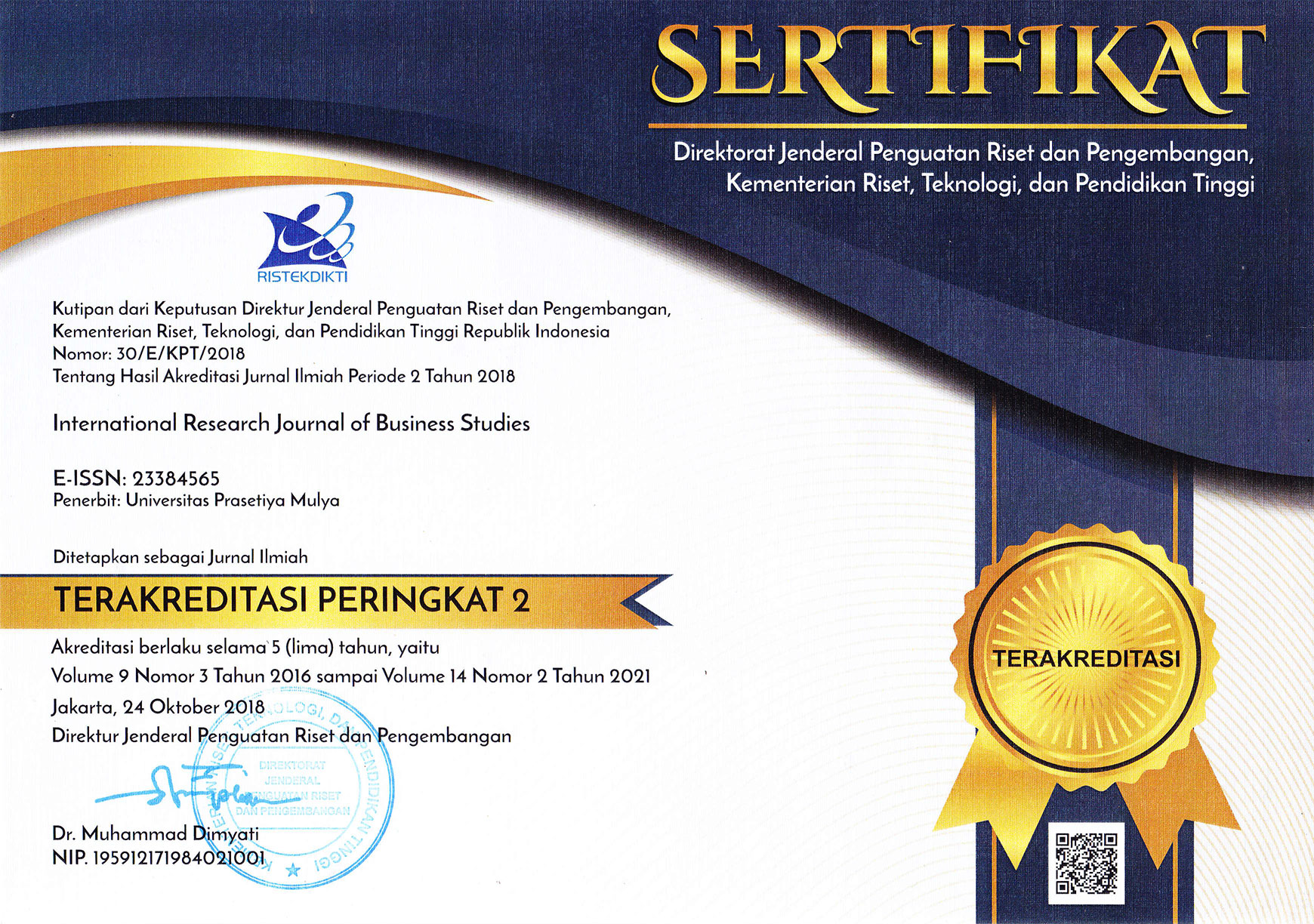
https://doi.org/10.21632/irjbs.6.1.63-72Keywords:
Foreign exchange reserve, GJR, Value-at-Risk, reserves-to-import ratioAbstract
Accumulating foreign exchange reserves, despite their cost and their impacts on other macroeconomics variables, provides some benefits. This paper models such foreign exchange reserves. To measure the adequacy of foreign exchange reserves for import, it uses total reserves-to-import ratio (TRM). The chosen independent variables are gross domestic product growth, exchange rates, opportunity cost, and a dummy variable separating the pre and post 1997 Asian financial crisis. To estimate the risky TRM value, this paper uses conditional Value-at-Risk (VaR), with the help of Glosten-Jagannathan-Runkle (GJR) model to estimate the conditional volatility. The results suggest that all independent variables significantly influence TRM. They also suggest that the short and long run volatilities are evident, with the additional evidence of asymmetric effects of negative and positive past shocks. The VaR, which are calculated assuming both normal and distributions, provide similar results, namely violations in 2005 and 2008.
References
Akdogan, K. (2010). Foreign Exchange Reserve Demand: An Information Value Approach. Central Bank Review, Central Bank of the Republic of Turkey, Vol. 10 (July 2010), 33-44.
Alam, M. Z. and Rahim, M. A. (2013). Foreign Exchange Reserves: Bangladesh Perspective. International Journal of Finance & Banking Studies, 12(4), 1-12.
Antal, J. and Gereben, A. (2011). Foreign Reserve Strategies for Emerging Economies - Before and After the Crisis. Magyar Nemzeti Bank (MNB) Bulletin, April, 7-19.
Bao, Y., Lee, T. H. and Saltoglu, B. (2006). Evaluating Predictive Performance of Value-at-Risk Models in Emerging Markts: A Reality Check. Journal of Forecasting, 25, 101-128.
Barnichon, R. (2009). The Optimal Level of Reserves for Low Income Countries: Self Insurance against External Shocks. IMF Staff Papers, Vol.56(4), 852-875.
Bhattacharyya, M., Chaudhary, A. and Yadav, G. (2007). Conditional VaR Estimation using Pearson’s Type IV Distribution. European Journal of Operational Research, 191, 386-397.
Borio, C., Galati, G. and Heath, A. (2008). FX Reserve Management: Trends and hallenges. BIS Papers, No 40.
Brooks, C., Clare, A. D., Molle, J. W. D., and Persand, G. (2005). A Comparions of Extreme Value Theory Approaches for Determining Valut at Risk. Journal of Empirical Finance, 12, 339-352.
Chan, N. H., Deng, S. J., Peng, L., and Xia, Z. (2007). Interval Estimation of Value-at-Risk based on GARCH Models with Heavytailed Innovations. Journal of Econometrics, 137, 556-576.
Chaudry, I. S., Akhtar, M. H., Mahmood, K. and Faridi, M. Z. (2011). Foreign Exchange Reserves and Inflation in Pakistan: Evidence from ARDL Modelling Approach. International Journal of Economics and Finance, 3(1), 69-76.
Chiou, J-S., Hung, J-C, and Hseu, M-M. (2008). A VaR Investigation of Currency Composition in Foreign Exchange Reserves. International Research Journal of Finance and Economics, 21, 76-92
Elhiraika, A. and Ndikumana, L. (2012). Reserves Accumulation in African Countries: Sources, Motivations, and Effects. Working Paper No. 2007-12, Department of Economics, University of Massachusetts Amherst.
Fukuda, S. and Kon, Y. (2010). Macroeconomic Impacts of Foreign Exchange Reserve Accumulation: Theory and International Evidence. ADBI Working Paper 197. Tokyo: Asian Development Bank Institute.
Glosten, L. R., Jagannathan, R. and Runkle, D. (1993). On the Relation between the Expected Value and the Volatility of the Normal Excess Return on Stocks. Journal of Finance, 48, 1779– 1801.
Gosselin, M-A. and Parent, N. (2005). An Empirical analysis of Foreign Exchange Reserves in Emerging Asia. Bank of Canada Working Paper 2005-38.
Gupta, A. and Agarwal, R. (2004). How Should Emerging Economies Manage their Foreign Exchange Reserves?” Retrieved from SSRN: http://ssrn.com/abstract=466783 or http://dx.doi.org/10.2139/ssrn.466783
Gupta, R., Hammoudeh, S. Kim, W. J., and Simo-Kengne, B.D. (2013). Forecasting China’s Foreign Exchange Reserves Using Dynamic Model Averaging: The Role of Macroeconomic Fundamentals, Financial Stress and Economic Uncertainty. Department of Economics Working Paper Series N0. 2013-38, University of Pretoria.
Jabr, R. A. (2005). Robust Self-Scheduling under Price Uncertainty Using Conditional Value-at-Risk. IEEE Transactions on Power Systems, 20(4), 1852-1858.
Ku, Y. H. H. and Wang, J. J. (2008). Estimating Portfolio Value-at-Risk via Dynamic Conditional Correlation MGARCH Model – An Empirical Study on Foreign Exchange Rates. Applied Economics Letters, 15, 533-538.
Mcaleer, M. (2005). Automated Inference and Learning in Modeling Financial Volatility. Econometric Theory, 21, 232–261.
Mcaleer, M., Chan, f. and Marinova, D. (2007). Econometric Analysis of Asymmetric Volatility: Theory and Application to Patents. Journal of Econometric, 139, 259–284.
Moghadam, R., Ostry, J. D. and Sheely, R. (2011). Assessing Reserve Adequacy. International Monetary Funds Paper, available at http://www.imf.org/external/np/pp/eng/2011/021411b.pdf.
Monetary and Capital Markets Department (2013). Revised Guidelines for Foreign Exchange Reserve Management. International Monetary Funds.
Ning, Z. (2014). Testing Time for China;s Foreign Exchange. China Daily, 2014, 02, 18, 1:16. Retrieved from http://usa.chinadaily.com.cn/business/2014-02/18/content_17289655.htm
Rodrik, D. (2006). The Social Cost of Foreign Exchange Reserves. International Economic Journal, 20, 253-266.
Romero, A. M. (2005) “Comparitive Study: Factors that Affect Foreign Currency Reserves in China and India. The Park Place Economist, 13(1), 79-88.
Sianturi, M. P. (2011), Hubungan Kausalitas Impor Dan Impor terhadap Cadangan Devisa Indonesia, USU Instutional Repository Open Access, available at http://repository.usu.ac.id/handle/123456789/25793.
Siregar, R. and Rajan, R. (2003). Exchange Rate Policy and Foreign Exchange Reserves Management in Indonesia in the Context of East Asian Monetary Regionalism. Discussion Paper No. 0302, University of Adelaide, Adelaide 5005 Australia.
Sultan, Z. A. (2011). Foreign Exchange Reserves and India’s Import Demand: A Cointegration and Vector Error Correction Analysis. International Journal of Business and Management, 6(7), 69-76.
The World Bank (2014), Data, The World Bank Group, available at http://data.worldbank.org/indicator/FI.RES.TOTL.MO.
Wijnholds, J. O. D. B. and Kapteyn, A. (2011). Reserve Adequacy in Emerging Market Economies. IMF Woking Paper, WP/01/143.
Yeyati, E. L. (2006). The Cost of Reserves. World Bank Working Paper No. 585. Washington DC, World Bank.
Zeng, S. (2012). Study on Chinese Foreign Exchange Reserves. Journal of Applied Finance & Banking, 2(1), 29-67.
Downloads
Submitted
Published
How to Cite
Issue
Section
License
Copyright (c) 2013 Abdul Hakim

This work is licensed under a Creative Commons Attribution-ShareAlike 4.0 International License.
Journal Author(s) Rights
For IRJBS to publish and disseminate research articles, we need publishing rights (transferred from the author(s) to the publisher). This is determined by a publishing agreement between the Author(s) and IRJBS. This agreement deals with the transfer or license of the copyright of publishing to IRJBS, while Authors still retain significant rights to use and share their own published articles. IRJBS supports the need for authors to share, disseminate and maximize the impact of their research and these rights, in any databases.
As a journal Author, you have rights to many uses of your article, including use by your employing institute or company. These Author rights can be exercised without the need to obtain specific permission. Authors publishing in IRJBS journals have comprehensive rights to use their works for teaching and scholarly purposes without needing to seek permission, including:
- use for classroom teaching by Author or Author's institution and presentation at a meeting or conference and distributing copies to attendees;
- use for internal training by the author's company;
- distribution to colleagues for their research use;
- use in a subsequent compilation of the author's works;
- inclusion in a thesis or dissertation;
- reuse of portions or extracts from the article in other works (with full acknowledgment of the final article);
- preparation of derivative works (other than commercial purposes) (with full acknowledgment of the final article);
- voluntary posting on open websites operated by the author or the author’s institution for scholarly purposes,
(But it should follow the open access license of Creative Common CC-by-SA License).
Authors/Readers/Third Parties can copy and redistribute the material in any medium or format, as well as remix, transform, and build upon the material for any purpose, even commercially. Still, they must give appropriate credit (the name of the creator and attribution parties (authors' detail information), a copyright notice, an open access license notice, a disclaimer notice, and a link to the material), provide a link to the license, and indicate if changes were made (Publisher indicates the modification of the material (if any) and retain an indication of previous modifications.
Authors/Readers/Third Parties can read, print and download, redistribute or republish the article (e.g. display in a repository), translate the article, download for text and data mining purposes, reuse portions or extracts from the article in other works, sell or re-use for commercial purposes, remix, transform, or build upon the material, they must distribute their contributions under the same license as the original Creative Commons Attribution-ShareAlike (CC BY-SA).

This work is licensed under a Creative Commons Attribution-ShareAlike 4.0 International License.