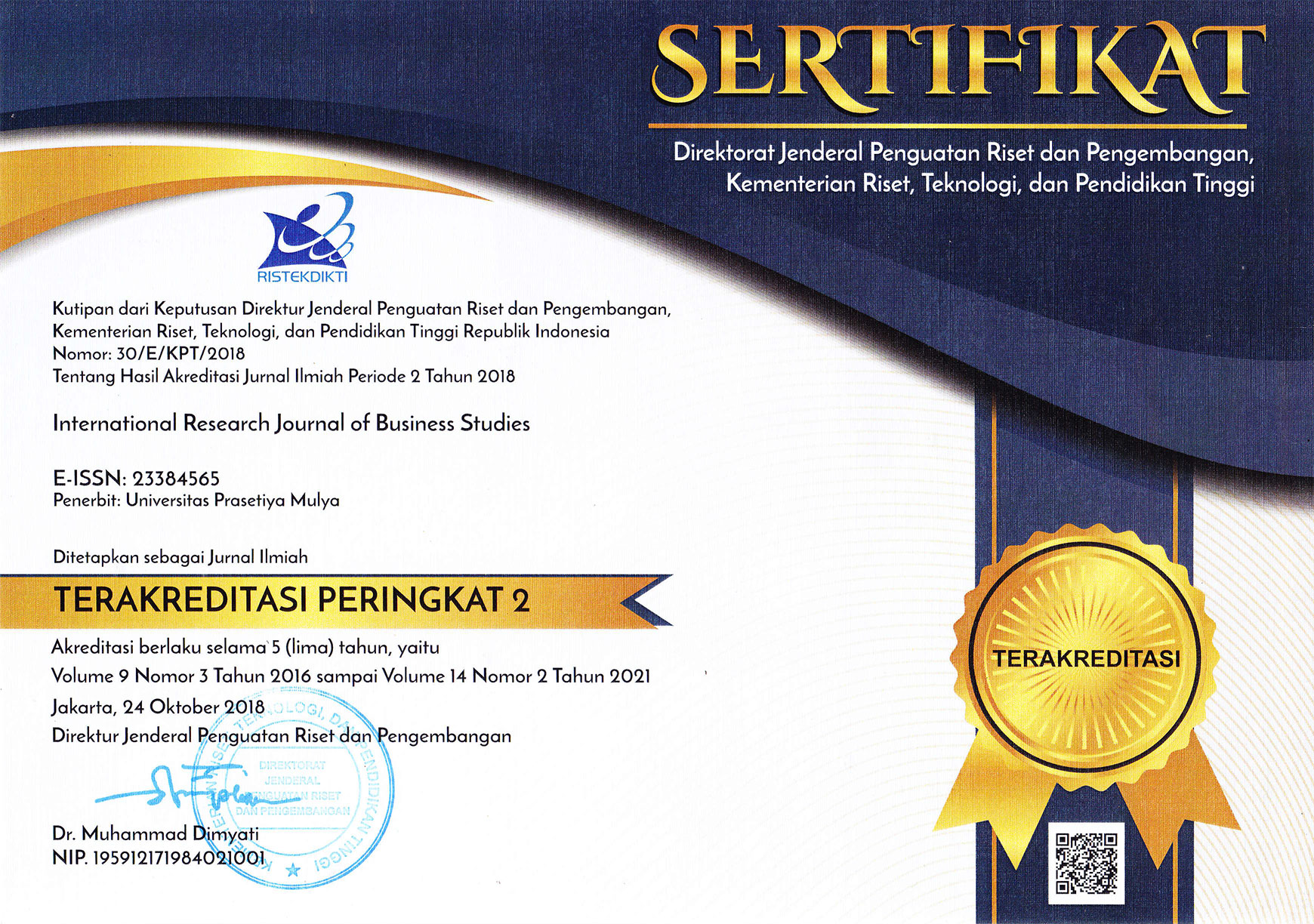
Marketing Mix is The Only Variable to Choose Brands and Quality?
DOI:
https://doi.org/10.21632/irjbs.6.3.203-213Keywords:
marketing mix, family, brand equity, perceived qualityAbstract
This research is to find out how the role and influence of marketing stimuli (advertising, pricing, and sales promotion) as well as the role of family and brand awareness, brand associations, perceived quality of Pepsodent toothpaste. The benefits of this research study is expected to be considered in developing a marketing mix that ultimately led to the formation of perceived qualitys. Second, updating the theory of consumer behavior and marketing theory. This research method is accomplished by using a descriptive study using survey. The population in this study is consumer of Pepsodent toothpaste. Samples done by accidental sampling. For data collection questionnaire used closed type. Operationalization variable using descriptive and quantitative analysis variable (GSCA and SEM). The results showed the influence of very low ranging from 0.00 to 0.19 for the relationship of advertising and brand awareness variables, the price and brand association variables, promotion and brand awareness variables, relationship between family variable and brand awareness and brand association. While family variable and perceived quality variable had reverse effect. The low but definite effect ranged from 0.20 to 0.39 for the advertising variable, brand associations variable, and perceived quality as well as variable promotion, promotional variable to variable brand associations and perceived quality variables. The effect was ranged from 0.40 to 0.60 for brand awareness and perceived quality variables. Recommendations to PT Unilever should deliver more competitive promotion thus proving that good quality is always supported by good and great promotion, low price version. Pepsodent should promote impressed with quality, still showing the previous experience of the people who have benefited from Pepsodent, while providing marketing and advertising top of mind to their customers so that they lose sight of the Pepsodent, still suggested best quality can be compared with its competitors, the evidence suggests that the quality is always the best.
Downloads
References
Bohrer, M. F. (2007). Discriminant analysis of Aaker’s band equity on top of mind awareness. (Doctoral), Anderson, Anderson.
Buschken, J. (2007). Determinants of brand advertising efficiency. Journal of Advertising, 36(3), 51-73.
Chiang, Y. S., & Niu, H. J. (2013). Advertising expenditure and price asjoint indicators of product quality. International Management Review, 9(1), 78-88.
Conradie, E., R.L., M., & Klopper, H. B. (2014). Brand awareness in the service sector influenced by eight internal marketing elements. Journal of Global Business Technology, 10(1), 25-37.
David, N. S. (2014). The use and misuse of structural equation modelling in management research: A review and critique. Journal of Advances in Management Research, 11(1), 47-81.
Deepa, S., & Chitramani, P. (2013). Brand building of retail stores. Journal of Contemporary Research in Management, 8(2), 9-24.
Faryabi, M., S.F., K., & Saed, M. (2015). Brand name, sales promotion, and consumers’ online purchase intention for cellphone brands. International Journal of Marketing Studies, 7(1), 167-179.
Ghozali, I. (2004). Model persamaan strukutral. Semarang: Badan Penerbit Undip.
Gil, R. B., Andres, E. F., & Salinas, E. M. (2007). Family as a source of consumer based brand equity. Journal of Product and Brand Management, 16(3), 188-199.
Gilaninia, S., Delafrooz, N., & Dokht, S. (2012). The role of family in creating brand equity from perpective of bank customers. Journal of Basic and Applied Scientific Research, 2(9), 8906-8911.
Jeong, J. (2004). Exploring the impact of advertising on brand equity and sharehorlder value. (Doctoral), Univerisity of Texas at Austin, Austin.
Jorgensen, S., Taboubi, S., & Zaccoure, G. (2003). Cooperative advertising in a marketing channel. Journal of Optimization Theory and Applications, 110(1), 145-158.
Keller, K. L. (2003). Building, measuring, and managing brand equity (2 ed.). New Jersey: Prentice Hall.
Moore, E. S., Wilkie, W. L., & Lutz, R. J. (2002). Passing the torch: Intergenarational influences as a source of brand equity Journal of Marketing, 66(April), 17-37.
Norgaard, M. K., Bruns, K., Christensen, P. H., & Mikkelsen, M. R. (2007). Children’s influence on and participation in the family decision process during food buying. Emerrald Insight, 8(3), 197-216.
Shaharudin, M. R., Mansor, S. W., Hassan, A. A., Omar, M. W., & Harun, E. H. (2011). The relationship between product quality and purchase intention. African Journal of Business Management, 5(20), 8163-8176.
Swait, J., & Erdem, T. (2022). The effects of temporal consistency of sales promotions and availability on consumer choice behavior. Journal of Marketing Research, 39(3), 304-320.
Villarejo, A. F., & Sanchez-Franco, M. J. (2005). The impact of marketing communication and price promotion on brand equity. Journal of Brand Management, 12(6), 431-445.
Yoo, B., Donthu, N., & Lee, S. (2000). An examination of selected marketing mix elements and brand equity. Academy of Marketing Science Journal, 28(2), 195-211.
Yoo, B., & Dontu, N. (2001). Developing and validating a multidomensional consumer-based brand equity scale. Journal of Business Research, 52(1), 1-14.
Downloads
Published
Issue
Section
License
Copyright (c) 2013 Umbas Krisnanto

This work is licensed under a Creative Commons Attribution-ShareAlike 4.0 International License.
Journal Author(s) Rights
For IRJBS to publish and disseminate research articles, we need publishing rights (transferred from the author(s) to the publisher). This is determined by a publishing agreement between the Author(s) and IRJBS. This agreement deals with the transfer or license of the copyright of publishing to IRJBS, while Authors still retain significant rights to use and share their own published articles. IRJBS supports the need for authors to share, disseminate and maximize the impact of their research and these rights, in any databases.
As a journal Author, you have rights to many uses of your article, including use by your employing institute or company. These Author rights can be exercised without the need to obtain specific permission. Authors publishing in IRJBS journals have comprehensive rights to use their works for teaching and scholarly purposes without needing to seek permission, including:
- use for classroom teaching by Author or Author's institution and presentation at a meeting or conference and distributing copies to attendees;
- use for internal training by the author's company;
- distribution to colleagues for their research use;
- use in a subsequent compilation of the author's works;
- inclusion in a thesis or dissertation;
- reuse of portions or extracts from the article in other works (with full acknowledgment of the final article);
- preparation of derivative works (other than commercial purposes) (with full acknowledgment of the final article);
- voluntary posting on open websites operated by the author or the author’s institution for scholarly purposes,
(But it should follow the open access license of Creative Common CC-by-SA License).
Authors/Readers/Third Parties can copy and redistribute the material in any medium or format, as well as remix, transform, and build upon the material for any purpose, even commercially. Still, they must give appropriate credit (the name of the creator and attribution parties (authors' detail information), a copyright notice, an open access license notice, a disclaimer notice, and a link to the material), provide a link to the license, and indicate if changes were made (Publisher indicates the modification of the material (if any) and retain an indication of previous modifications.
Authors/Readers/Third Parties can read, print and download, redistribute or republish the article (e.g. display in a repository), translate the article, download for text and data mining purposes, reuse portions or extracts from the article in other works, sell or re-use for commercial purposes, remix, transform, or build upon the material, they must distribute their contributions under the same license as the original Creative Commons Attribution-ShareAlike (CC BY-SA).

This work is licensed under a Creative Commons Attribution-ShareAlike 4.0 International License.