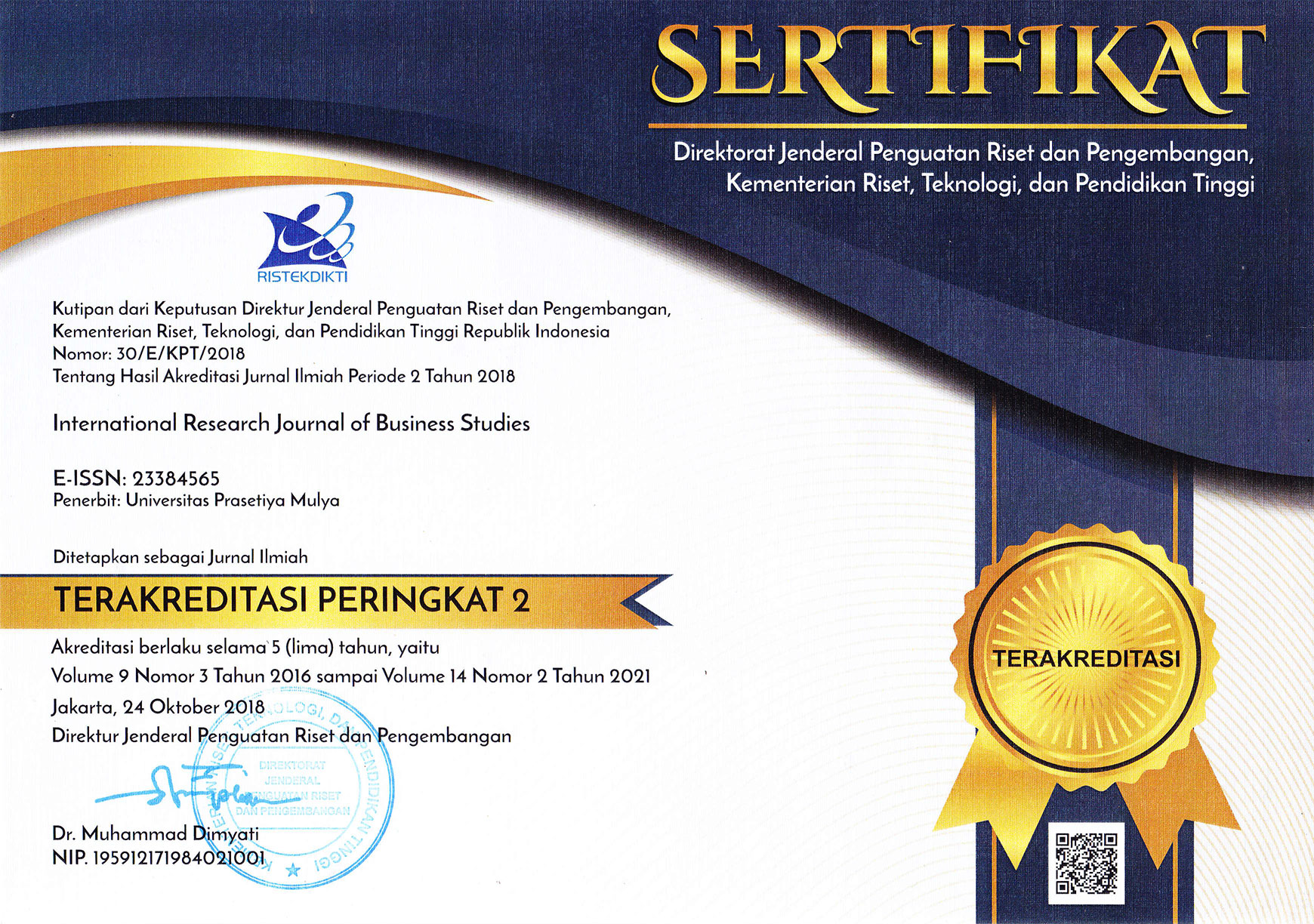
Soft Skill Competencies, Hard Skill Competencies, and Intention to Become Entrepreneur of Vocational Graduates
DOI:
https://doi.org/10.21632/irjbs.9.2.119-132Keywords:
entrepreneur, competency, intentionAbstract
This study aimed to determine the effect of soft skill competencies and hard skill competencies to the intention to become entrepreneur in the vocational school graduates. Hard skill entrepreneurial competencies are competencies that are needed to running business. Meanwhile for soft skill competencies are competencies related to aspects of personality and cognitive style. Population in this research is vocational graduates in Jakarta and Jogjakarta. The sampling technique used is
incidental sampling. We used measuring instruments as follow: the intention to become entrepreneur of Shapero & Sokol (in Riyanti, 2009). soft skill competencies of Spencer & Spencer (1993) and hard skill competencies of Chou. Shen. Hsiou & Chen. 2010). The regression analysis of the 258 respondents showed significant effect of soft skill competencies (initiative. self-confidence and assertiveness) to the intention to become entrepreneur in the vocational school graduates. There are significant effect hard skill competencies (human resources capability competency and production capability competency) to the intention to be entrepreneur. Based on the results. we suggested that the learning process should be more emphasis on direct practice so that more competencies can be formed on vocational school graduates.
References
Anastasi, A. & Urbina, S. (1997). Psychological testing (7th ed.). New Jersey: Prentice Hall.
Ajzen, I. (1991). The theory of planned behavior. Organizational behavior and human decision processes, 50, 179-211.
Ajzen, I. Fishbein, M. (2005). Theory-based behavior change intervention: comments on hobbis and sutton. Journal of health psychology, 10 (1), 27-31.
Callisen, L. (2015). 6 Soft Skills for Entrepreneurs: A Guide to Success. www.startupnation.com/articles/6-soft-skillsentrepreneurs-guide-success/oct 12, 2015.
Chou, C.M.; Shen, C.H;, Hsiao, H.C, Chen, S.C. (2010). A Study on Constructing Entreprenurial competence indicators for business departement students of vocational and technical colleges in Taiwan. World Transactions on Engineering and Technology Education, 8 (3), 316-319.
Douglas , E.J., & Shepherd, D.A. (1997). Entrepreneurial Atiitudes and Intentions of Career Decision Makers. Working Paper at Kellog Graduate School of Management, Northwestern University. Download 31-10-2013 from website: http://www.researchgate.net/publication/2436596_Entrepreneurial_Attitudes_and_Intentions_of_Career_Decision_Makers
Fayolle, A. & DeGeorge, J.M. (2006). Attitudes, Intention and Behavior: New Approaches to Evaluating Entrepreneurship Education. Issues and Newness. Edward Elger Publishing Limited.
Fitriati R. & Hermiatu T. (2010). Entrepreneurial skills and characteristics analysis on the graduates of Departement of Administrative Sciences, FISIP Universitas Indonesia. Journal of Administrative Science & Organization, 262-275.
Hamidi, D.Y., Wennberg, K., Berglund,H. (2008). Creativity in entrepreneurship education. Journal of Small Business and Enterprise Development, 15 (2), 304-320.
Krueger, N, Jr.; Reilly, M.; Carsrud, A., (2000). Competing models of entrepreneurial intention. Journal of Business Venturing, 15 (2), 177-194.
Kumar,R. (2005). Research Methodology: A Step by Step Guide for Beginners. London:Sage Publication Inc.
Linan, F & Juan C.R. & Jose, M.R.C, (2011). Factors affecting entrepreneurial intention levels: a role for education. Entrepreneur Management Journal , 7,195-218.
Mitchelmore, & Rowley, J. (2010). Entrepreneurial Competencies: A Literature Resee and Development Agenda.
Article in International Journal of Entrepreneurial Behaviour & Research 16(2):92-111. Website: Http://www.
Researchgate.net/.../235277302_entrepreneurial competee.
Othman, A.K., Hashim, M.A., Zahari, (2010). The Influence of Entrepreneurship Education and Experience on Students’ entrepreneurship spirit: The Moderating Effect of Internal Locus of Control. Advances in Business Research International Journal.
Paramita, R.P. (2014). SMK Penyumbang Pengangguran Terbesar. http://beritagar.id/artikel/berita/smk-penyumbangpengangguran terbesar.
Rasmussen, S.A. &Sorheim, R. (2006). Action-based entrepreneurship education. Technovation, 26 (2), 186-94.
Riyanti,B.P.D., (2009). Kewirausahaan Bagi Mahasiswa. Jakarta: Unika Atmajaya. Scarborough, N., Wilson, D.L., Zimmerer, T.
(2011). Essentials of Entrepreneurship and Small Business Management. Prentice-Hall.
Shermon, G. (2004). Competency Based HRM: A Strategic Resource for Competency Mapping, Assessment and Development Centres. Tata McGraw-Hill
Shepherd, D.A., &Douglas, E.J., (1997). Is management education developing, or killing, the entrepreneurial spirit. Paper presented at he 1997 USASBE Annual National Conference Entrepreneurship: The engine of global economic development, San Fransisco, California.
Spencer, L.M.& Spencer, S.M. (1993). Competence at work. Canada: John Wiley & Sons, Inc.
Vyakarnam, S. (2009). Driving force of entrepreneurship education. In Educating the new wave of entrepreneurs: Unlocking entrepreneurial capabilities to meet the global challenges of 21st century; Edited by C. Volkmann, K.E., Wilson, S. Mariotti, D., Rabuzzi, S., Vyarkarman and A Sepulveda. Cologny, Switzerland: Work economy forum.
Zakaria, S, Fadzilah W, Yusoff, W. (2011). Entrepreneurship Education in Malaysia: Nurturing Entrepreneurial Interest Among Students. Journal of Modern Accounting and Auditing, ISSN 1548-6583, 7 (6), 615-620.
Zhang, H. & Zhang, Y. (2013). Psychological characteristics of Entrepreneurship of college students in China. Scientific research Psychology, 4 (3), Published online March 2013 in SciRes. Website: http://www/scrip.org/journal/psych
Downloads
Submitted
Published
How to Cite
License
Copyright (c) 2016 Benedicta Prihatin Dwi Riyanti, Christine Winstinindah Sandroto, M. Tri Warmiyati D.W

This work is licensed under a Creative Commons Attribution-ShareAlike 4.0 International License.
Journal Author(s) Rights
For IRJBS to publish and disseminate research articles, we need publishing rights (transferred from the author(s) to the publisher). This is determined by a publishing agreement between the Author(s) and IRJBS. This agreement deals with the transfer or license of the copyright of publishing to IRJBS, while Authors still retain significant rights to use and share their own published articles. IRJBS supports the need for authors to share, disseminate and maximize the impact of their research and these rights, in any databases.
As a journal Author, you have rights to many uses of your article, including use by your employing institute or company. These Author rights can be exercised without the need to obtain specific permission. Authors publishing in IRJBS journals have comprehensive rights to use their works for teaching and scholarly purposes without needing to seek permission, including:
- use for classroom teaching by Author or Author's institution and presentation at a meeting or conference and distributing copies to attendees;
- use for internal training by the author's company;
- distribution to colleagues for their research use;
- use in a subsequent compilation of the author's works;
- inclusion in a thesis or dissertation;
- reuse of portions or extracts from the article in other works (with full acknowledgment of the final article);
- preparation of derivative works (other than commercial purposes) (with full acknowledgment of the final article);
- voluntary posting on open websites operated by the author or the author’s institution for scholarly purposes,
(But it should follow the open access license of Creative Common CC-by-SA License).
Authors/Readers/Third Parties can copy and redistribute the material in any medium or format, as well as remix, transform, and build upon the material for any purpose, even commercially. Still, they must give appropriate credit (the name of the creator and attribution parties (authors' detail information), a copyright notice, an open access license notice, a disclaimer notice, and a link to the material), provide a link to the license, and indicate if changes were made (Publisher indicates the modification of the material (if any) and retain an indication of previous modifications.
Authors/Readers/Third Parties can read, print and download, redistribute or republish the article (e.g. display in a repository), translate the article, download for text and data mining purposes, reuse portions or extracts from the article in other works, sell or re-use for commercial purposes, remix, transform, or build upon the material, they must distribute their contributions under the same license as the original Creative Commons Attribution-ShareAlike (CC BY-SA).

This work is licensed under a Creative Commons Attribution-ShareAlike 4.0 International License.