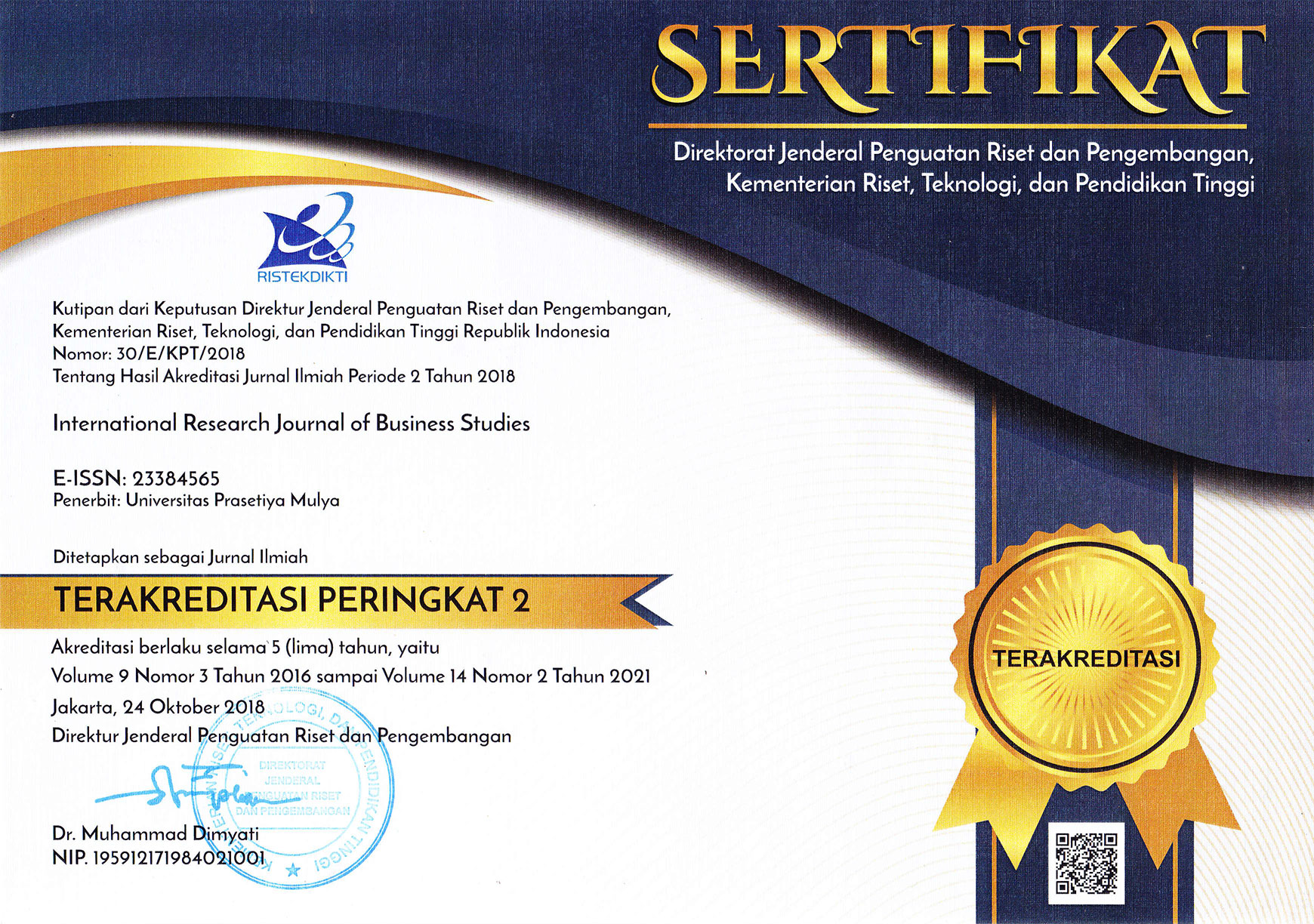
The Impact of Mobile Internet Adoption by Cocoa Farmers: A Case Study in Southern East Java, Indonesia
DOI:
https://doi.org/10.21632/irjbs.8.2.97-106Keywords:
Business Performance, Creativity, Innovativeness, Cocoa Farmer, Mobile InternetAbstract
The objective of this paper is to examine the impact of mobile internet adoption by cocoa farmers into their business performance. The main factors examined in this study are creativity and innovativeness. The study sample consists of 193cocoa farmers with 24% smart phone penetrationin thirteen cocoa farmer centers in southern East Java. Data were analyzed by employing Structural Equation Modeling (SEM). The findings revealed that the business performance is significantly impacted by creativity and innovativeness. Creativity and innovativeness was measured by new product development, new process, and new marketing way; while business performance was measured by sales increase, profitability improvement and market share. This research has a limitation that the generalizability of the findings is limited to the geographical scope of the sample. Based on findings, as the practical implications of this study, to give a meaningful broadband to the farmers, all stake holders need to build a conducive broadband ecosystem for the farmer by providing better access to device, user friendly applications, and better broadband customer experience.
References
Amabile, T. M., ContiR., CoonH., LazenbyJ., &HerronM., (1996).Assessing the Work Environment for Creativity. Academy of Management Journal. 39(5): 1154–1184.
Boston Consulting Group. (2010) Socio-economic impact of allocating 700MHz band to mobile in Asia Pacific.
Blitar, Kota penentu harga kakao Indonesia. (2015, April 18). umkmnews.com
Borghini S. (2005) Organizational creativity: breaking equilibrium and order to innovate. Journal of Knowledge Management. 9(4):19-33.
Choi B. (2005) Organizational Performance: An Integration and Empirical Examination [dissertation] Seoul (KR). Korea Advanced Institute of Science and Technology.
Daryanto A. (2009) Dinamika Daya Saing Industri Peternakan. Bogor (ID). IPB Pr.
Davis FD.(1985) A Technology Acceptance Model for empirical testing new end-user information system: theory and result [dissertation] Cambridge (US). MIT Sloan School of Management. .
Arthur D. Little (2011) New study quantifies the impact of broadband speed on GDP [Internet]. [Downloaded 2013 Okt 19]. Available at http://www.ericsson.com/ news/ 1550083.
Food and Agricultural Organization of The United Nations (2013) ICT uses for inclusive agricultural value chains. Rome (IT).
Gumbira-Said E. (2010) Wawasan, Tantangan, dan Peluang Agrotechnopreneur Indonesia. Bogor (ID). IPB Pr.
International Cocoa Organization (2012) The Future of the World Cocoa Economy: Boom or Bust? The World Cocoa Conference. 2012 Nov 19-23. Abidjan. Cote d’Ivoire.
Khalifa M. & Shen K.N. (2008) Explaining the adoption of transactional B2C mobile commerce. Journal of Enterprise Information Management. 21:110-124.
Lin C.Y.Y. & Liu F.C. 2012. A cross-level analysis of organizational creativity climate and perceived innovation. European Journal of Innovation Management. 15 (1): 55-76
Nabhani I, Daryanto A, Yassin M, Rifin A. (2015) Can Indonesia Cocoa Farmers Get Benefit on Global Value Chain Inclusion? A Literature Review. Journal of Asian Social Science. 11(18): 1-7.
Nabhani I, Daryanto A, Yassin M, Rifin A. (2015) M-Commerce Adoption and Performance Improvement: Proposing a Conceptual Framework. International Journal of Economics, Commerce and Management. 3(4).
Najib M, Kiminami A. (2011) Innovation, cooperation and business performance: Some evidence from Indonesian small food processing cluster. Journal Agribusiness in Developing and Emerging Economies. 1(1):75-96
Panlibuton H, Meyer M. (2004) Value Chain Assessment: Indonesia Cocoa. Accelerated Microenterprise Advancement Project. Report#2
Penentu Harga Kakao Nasional, Coklat Blitar Justru Tak Dikenal. (2015, April 18). beritajatim.com
Potret Rupiah di Kampung Cokelat Blitar. (2015, April 6). antarajatim.com
Swilley E. (2007) An Empirical Examination of the Intent of Firms to Adopt Mobile Commerce as a Marketing Strategy [dissertation]. Florida (US). Florida State University.
United Nations Development Programme (2012) Promoting ICT based agricultural knowledge management.
United States Agency for International Development (2013) ICT Applications And Agricultural Input Supply Companies: Highlights From Africa. Briefing Paper Feb 2013.
-------------------(2013) Using ICT to Enhance Marketing for Small Agricultural Producers, Briefing Paper May 2013.
------------------- (2013) Market Insights Into The Financial Behaviors And Design Of Mobile Financial Services Products For Cocoa Farmers In Indonesia.
Woodman RW, Sawyer JE, Griffin RW. (1993) Toward a theory of organizational creativity. Academy of Management Review. 18(2): 293
Zhang J. 2009. Exploring Drivers in the Adoption of Mobile Commerce in China. Journal of American Academy of
Busines.15:64-69.
Downloads
Submitted
Published
How to Cite
Issue
Section
Categories
License
Copyright (c) 2015 Irfan Nabhani, Arief Daryanto, Machfud, Amzul Rifin

This work is licensed under a Creative Commons Attribution-ShareAlike 4.0 International License.
Journal Author(s) Rights
For IRJBS to publish and disseminate research articles, we need publishing rights (transferred from the author(s) to the publisher). This is determined by a publishing agreement between the Author(s) and IRJBS. This agreement deals with the transfer or license of the copyright of publishing to IRJBS, while Authors still retain significant rights to use and share their own published articles. IRJBS supports the need for authors to share, disseminate and maximize the impact of their research and these rights, in any databases.
As a journal Author, you have rights to many uses of your article, including use by your employing institute or company. These Author rights can be exercised without the need to obtain specific permission. Authors publishing in IRJBS journals have comprehensive rights to use their works for teaching and scholarly purposes without needing to seek permission, including:
- use for classroom teaching by Author or Author's institution and presentation at a meeting or conference and distributing copies to attendees;
- use for internal training by the author's company;
- distribution to colleagues for their research use;
- use in a subsequent compilation of the author's works;
- inclusion in a thesis or dissertation;
- reuse of portions or extracts from the article in other works (with full acknowledgment of the final article);
- preparation of derivative works (other than commercial purposes) (with full acknowledgment of the final article);
- voluntary posting on open websites operated by the author or the author’s institution for scholarly purposes,
(But it should follow the open access license of Creative Common CC-by-SA License).
Authors/Readers/Third Parties can copy and redistribute the material in any medium or format, as well as remix, transform, and build upon the material for any purpose, even commercially. Still, they must give appropriate credit (the name of the creator and attribution parties (authors' detail information), a copyright notice, an open access license notice, a disclaimer notice, and a link to the material), provide a link to the license, and indicate if changes were made (Publisher indicates the modification of the material (if any) and retain an indication of previous modifications.
Authors/Readers/Third Parties can read, print and download, redistribute or republish the article (e.g. display in a repository), translate the article, download for text and data mining purposes, reuse portions or extracts from the article in other works, sell or re-use for commercial purposes, remix, transform, or build upon the material, they must distribute their contributions under the same license as the original Creative Commons Attribution-ShareAlike (CC BY-SA).

This work is licensed under a Creative Commons Attribution-ShareAlike 4.0 International License.